Abu Simbel Temples Explained: Ramses II, Nefertari and the Great Move
By Islam Hussein · November 18, 2026
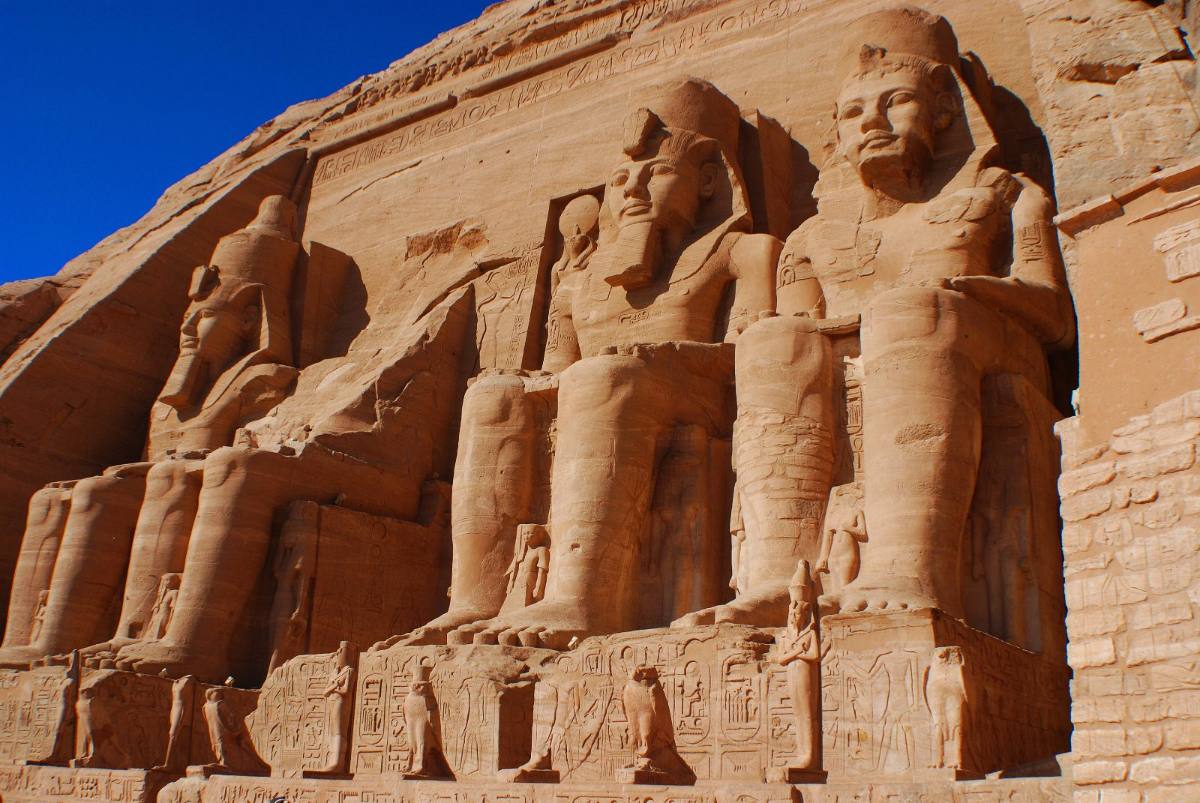
In short: The Abu Simbel temples were carved from a sandstone cliff in Nubia for Ramses II in the 13th century BCE: a Great Temple for the king beside the gods Amun-Ra, Ra-Horakhty and Ptah, and a smaller one for his queen Nefertari and the goddess Hathor. When the Aswan High Dam threatened to drown them beneath Lake Nasser, UNESCO's rescue campaign cut both temples into more than a thousand blocks and rebuilt them on higher ground, finishing in 1968. Today they are among the best-known monuments of the World Heritage site Nubian Monuments from Abu Simbel to Philae.
Prices, timetables and visiting details are a November 2026 snapshot. Check the linked official pages and your departure’s current inclusions and terms before booking.
The quick answer
The Abu Simbel temples were carved from a sandstone cliff in Nubia for Ramses II in the 13th century BCE: a Great Temple for the king beside the gods Amun-Ra, Ra-Horakhty and Ptah, and a smaller one for his queen Nefertari and the goddess Hathor. When the Aswan High Dam threatened to drown them beneath Lake Nasser, UNESCO's rescue campaign cut both temples into more than a thousand blocks and rebuilt them on higher ground, finishing in 1968. Today they are among the best-known monuments of the World Heritage site Nubian Monuments from Abu Simbel to Philae.
UNESCO explains the Nubian monuments and the international rescue of Abu Simbel and Philae.
Key facts
| Fact | Detail |
|---|---|
| Where | Abu Simbel, in Lower Nubia on the shore of Lake Nasser, about 280 km and 3.5 to 4 hours by road south of Aswan |
| Built | About 1264 to 1244 BCE, in the reign of Ramses II (ruled 1279 to 1213 BCE); building took roughly 20 years |
| The two temples | Great Temple: the deified Ramses II beside Amun-Ra, Ra-Horakhty and Ptah. Small Temple: Queen Nefertari and the goddess Hathor |
| Signature sights | Four seated colossi of Ramses II, each about 20 m high; the Battle of Kadesh reliefs; six statues of about 10 m on the Small Temple facade, with the queen the same height as the king |
| The Great Move | 1960s: both temples cut into 1,036 blocks and rebuilt about 65 m higher and some 200 m further back from the water, inside an artificial hill. Rededicated on 22 September 1968 |
| UNESCO status | Nubian Monuments from Abu Simbel to Philae, World Heritage since 1979 |
| Time needed | About 2 hours on site; the Sawa day tour from Aswan runs about 9 hours door to door |
| Typical cost | The site ticket is EGP 750 for a foreign adult (Wego, July 2026). The Sawa day tour is from €50 per person, as listed in November 2026, with hotel pickup in Aswan, a guide, an air-conditioned car, lunch and the Abu Simbel tickets included |
| Best time | October to April for cooler weather. The two sun-alignment mornings, around 22 February and 22 October, are far busier: see our Abu Simbel sun festival guide |
| Join it on Sawa | Aswan to Abu Simbel: Temples of Ramses II & Nefertari, from €50 |
Abu Simbel looks impossible even when you are standing in front of it: four 20-metre pharaohs cut from a sandstone cliff above Lake Nasser, and a second temple where the queen stands as tall as the king. Stranger still, neither temple is where it was built. In the 1960s both were sawn into blocks and rebuilt higher up, out of the water's reach. This post explains the history of the Abu Simbel temples: why Ramses II built them, what is inside each one, and how engineers moved a mountain. It is about the history rather than the sunrise light show, which has its own guide. Sawa Tours (sawa.tours), the Egypt shared-departure platform, lists shared day trips here from Aswan, and its founder has worked in Egyptian tourism since 1993.
Abu Simbel temples history: why Ramses II carved a mountain
Ramses II built Abu Simbel to overawe. The two temples were carved early in his 66-year reign (he ruled from 1279 to 1213 BCE, the third king of the 19th Dynasty) in Lower Nubia, near Egypt's southern frontier. Anyone travelling up the Nile into Nubia met a message cut in stone: this king, these gods, this border. The Great Temple honoured Amun-Ra, Ra-Horakhty and Ptah alongside a deified Ramses himself; the smaller temple honoured Queen Nefertari with the goddess Hathor. Building took about 20 years and is usually dated to around 1264 to 1244 BCE.
What is inside the Great Temple of Ramses II?
The Great Temple runs deep into the cliff, some 60 metres from facade to sanctuary, and moves from public splendour to private holiness in four stages:
- The facade. Four seated colossi of Ramses II, each about 20 metres tall. One lost its head and torso in an earthquake, and the pieces lie at its feet. Above the door stands a falcon-headed Ra-Horakhty in a niche, with a frieze of baboons greeting the sun above.
- The hypostyle hall. Eight pillars carved as statues of the king in the form of Osiris, with dark side chambers beyond. The walls carry the Battle of Kadesh reliefs: Ramses' chariot battle against the Hittites, fought around 1274 BCE in what is now Syria.
- The vestibule. A smaller hall of offering scenes, the threshold of the sacred part of the temple.
- The sanctuary. Four seated figures at the back wall: Ptah, Amun-Ra, the deified Ramses II and Ra-Horakhty. On two mornings a year the rising sun reaches this far and lights all of them except Ptah, who stays in shadow.
Why is the Small Temple of Nefertari so special?
Because Nefertari stands as tall as the king, which is rare in Egyptian royal art. The Small Temple, about 100 metres north-east of the Great Temple, is dedicated to Hathor and to Queen Nefertari. Its facade carries six statues of a little over 10 metres: four of Ramses II and two of Nefertari, the queen shown at the king's height. Egypt's queens were usually shown small at the pharaoh's side; here Nefertari is his equal. Inside, columns topped with the face of Hathor replace the war scenes of the Great Temple, and the reliefs show the queen worshipping and being honoured by the gods. Nefertari was Ramses' Great Royal Wife, and the inscriptions place her beside him at the temple's dedication.
Why was Abu Simbel moved?
Abu Simbel was moved because of the Aswan High Dam. Built between 1960 and 1970, the dam created Lake Nasser, one of the world's largest reservoirs, and its rising water was set to drown the temples and many other monuments in Lower Nubia. Left where it stood, Abu Simbel would now be deep underwater. Egypt appealed to UNESCO for help in April 1959 and Sudan followed in October, and on 8 March 1960 UNESCO launched the International Campaign to Save the Monuments of Nubia. The campaign ran until 1980 and relocated 22 monuments and architectural complexes (counts vary slightly), among them Philae. Abu Simbel was the hardest job: two temples cut from solid rock, 3.5 to 4 hours by road south of Aswan.
How the relocation worked, step by step
Engineers solved it the only way that worked at this scale: saw both temples into blocks, lift them up the cliff, and rebuild them inside an artificial hill dressed to look like the original rock.
- 1959 to 1963: appeal and planning. Egypt and Sudan appealed to UNESCO in 1959 and the campaign was launched in 1960, after which a rescue method was chosen and funded.
- 1963 to 1966: dismantling. Wire saws began cutting in late 1963. In all, the temples were cut into 1,036 blocks, the heaviest around 30 tonnes. The first block was lifted in 1965 and the last in April 1966.
- 1966 to 1968: reassembly. The blocks were rebuilt on a new site about 65 metres higher and some 200 metres back from the river, over a concrete dome, with an artificial cliff built around it so the temples look natural from the lake.
- 22 September 1968: rededication. The temples reopened above the new shoreline, and the sun still finds the sanctuary twice a year.
The cost is quoted differently depending on the source. UNESCO's own account puts the Abu Simbel operation at about US$80 million, roughly half of it donated by some 50 countries; older accounts give figures around US$40 million. Either way it was the centrepiece of a campaign that also moved Philae, finished in 1980. In 1979 the Nubian Monuments from Abu Simbel to Philae were listed as World Heritage.
The Great Move in numbers: 1,036 blocks · up to about 30 tonnes each · about 65 metres up the cliff · rebuilt inside an artificial hill disguised as rock.
Visiting Abu Simbel today: early starts and lake views
Abu Simbel rewards an early start. The Sawa shared day tour from Aswan collects you from your Aswan hotel early, drives 3.5 to 4 hours through the Nubian desert, and gives you about two hours at the temples with a licensed guide. The whole day runs about 9 hours, with an air-conditioned car, lunch and the Abu Simbel tickets included, from €50 per person, as listed in November 2026. The site is generally open from 06:00 to 17:00, but hours change with the season and holidays.
- Do the Small Temple second. Groups tend to head for the Great Temple first; Nefertari's temple is calmer an hour in.
- Choose festival mornings knowingly. Around 22 February and 22 October the sunrise alignment draws very large crowds. That is a different trip from this one, and we cover it in the sun festival guide.
- Expect dim, narrow interiors. Lighting is kept low to protect the reliefs. Flash is not allowed, and professional photography needs a separate permit, so ask at the ticket booth.
- Pair it with an Aswan day. The five-hour Aswan Highlights tour (the Unfinished Obelisk, the High Dam and Philae by motorboat, from €36) fits the same stay.
How to do Abu Simbel with Sawa Tours
On Sawa, Abu Simbel runs as a shared departure: one tour on one date, with travellers from different selling agencies pooled into one group of at most eight. Browse a forming date or start your own on the Aswan to Abu Simbel day tour; Sawa's team reviews a new date before it opens. Reserving a seat is free and needs no card, and nothing is charged before the GoAhead. A date confirms when four travellers (people, not bookings) have reserved it. A 10% deposit is then due by payment link, and the balance is due 2 days (48 hours) before departure. A date has until 7 days before the tour to reach four; if it does not, it is cancelled, nothing is charged and another date is suggested. A confirmed date is not cancelled for low numbers.
The price is fixed per traveller, with no solo surcharge, and when a departure fills, a new, independent departure opens. If you cancel at least 48 hours before departure you are refunded in full, deposit included; inside 48 hours the 10% deposit is retained; and in a force majeure event you are refunded in full. A traveller who does not pay after the GoAhead is excluded, and the tour still runs. Payments go through a secure payment link from Online Era (General Sales Agent licence 32241); charges are in euros. The departure is operated by one of the licensed Egyptian agencies with travellers on the date, named before the deposit is due. Sawa's founding operating partner is Capital Travel Service (licence 2179), and Sawa Tours is operated by Online Era (registration 148500). The full rules are in the terms, how the GoAhead works and how it works; you can browse forming departures at any time, and WhatsApp +20 109 284 7613 is answered 24/7 while your tour is running.
The verdict: two temples, two stories
Abu Simbel is a pharaoh who carved himself beside the gods, and the 1960s engineers who sawed the mountain apart to save him: both stories in one long day from Aswan. Next step: check forming Abu Simbel departures on Sawa, or start your own date on the Aswan to Abu Simbel day tour. Reserving a seat is free.
About the author
Islam Hussein is an Egyptologist guide who has worked in Egyptian tourism since 1993, and the founder of Sawa Tours. More about Sawa Tours.
Related reading
- Deir el-Medina: Luxor's Overlooked Workers' Village
- Dendera & Abydos Day Trip from Luxor: Worth It?
- Dendera Temple: Zodiac, Crypts & Roof Chapels
Questions
Could the temples have been left where they were?
No. Lake Nasser stretches for hundreds of kilometres upstream from the High Dam, and the original site would have ended up permanently underwater. Moving the temples was the only way to keep them, which is why the Abu Simbel operation is often described as one of the greatest rescues in the history of archaeology.
Did moving the temples change the sun alignment?
Slightly, according to most accounts. The rising sun still reaches the inner sanctuary twice a year, and the dates are now given as around 22 February and 22 October. It is commonly said that the move shifted the alignment by about a day from the original dates, though the engineers worked to preserve the effect and the exact figure is debated. Expect large crowds on those two mornings; the sun festival guide has the detail.
How much did the Abu Simbel rescue cost?
Sources differ. UNESCO's account of the Abu Simbel operation gives about US$80 million, roughly half donated by some 50 countries, while older figures of around US$40 million are also quoted. The wider International Campaign to Save the Monuments of Nubia (1960 to 1980) relocated 22 monuments and architectural complexes, from Abu Simbel to Philae.
Is the Abu Simbel day trip from Aswan worth it?
For most travellers, yes, with eyes open. It is a long day: 3.5 to 4 hours on the road each way for roughly two hours at the temples. You see one of Egypt's signature sights with a licensed guide, and on the Sawa shared departure hotel pickup in Aswan, the Abu Simbel tickets and lunch are included, from €50 per person, as listed in November 2026.
What happens if my Abu Simbel departure doesn't fill?
Nothing is charged. A Sawa date confirms when four travellers have reserved it; a date has until 7 days before the tour to reach four, and if it does not, it is cancelled and you have paid nothing. Sawa suggests other dates. Once a date is confirmed, it is not cancelled for low numbers: a traveller who misses the deposit or the balance is excluded, and the tour continues for everyone else.