Fayoum in a Day from Cairo: Meidum, Hawara, and the Problem of Getting Between Them
By Islam Hussein · August 15, 2026
In short: The Fayoum is an easy two-hour hop from Cairo, but its three sites are spread over sixty kilometres with no transport between them. Independent works if you hire a car for the day; a shared vehicle splits that fixed cost four ways.
Most people who ask about the Fayoum have already done Giza. They've stood in front of the Sphinx, they've queued for the Grand Egyptian Museum, and now they're looking at a map wondering what's within reach of Cairo that isn't on every itinerary. The Fayoum comes up, usually attached to a photograph of a strange broken tower in the desert, and the question that follows is always the same: can I just get there myself?
The short answer: getting to the Fayoum is easy. Getting between the three things worth seeing, once you're there, is the part that catches people out. They're spread across roughly sixty kilometres of farmland and desert edge, they aren't connected to each other by any useful public transport, and one of them isn't in the Fayoum at all.
That's the whole logistical problem in a sentence. Here's what it looks like in practice.
What you're actually going to see
Three stops, and they have almost nothing in common except geography.
Meidum is a pyramid that failed. It began as a step pyramid in the tradition of Djoser at Saqqara, then the design changed mid-build: the steps were packed out and cased in smooth limestone to make Egypt's first true pyramid. The casing came away — during construction, shortly after, or slowly over centuries, depending on which archaeologist you believe — leaving the inner core standing as a bare three-stage tower ringed by an enormous skirt of its own rubble. The Arabic name translates as "the false pyramid," which is fair.
It was completed under Sneferu, who went on to build the Bent Pyramid and then the Red Pyramid at Dahshur, and whose engineers arrived at the geometry his son Khufu used at Giza. Meidum is where the mistake happened that made the success possible. You can climb into the burial chamber if you want to.
Meidum — the inner core of Egypt's first true pyramid, standing in the skirt of its own fallen casing.
Hawara is a different kind of ruin. Amenemhat III's Middle Kingdom pyramid is a great blunted hill of mud brick, four thousand years of weather having taken most of its shape. But the pyramid isn't why anyone came here. Beside it once stood a mortuary complex that Herodotus said surpassed the pyramids themselves — twelve roofed courts, chambers past counting, an underground level he wasn't allowed into. He called it the Labyrinth. Strabo and Pliny wrote about it too.
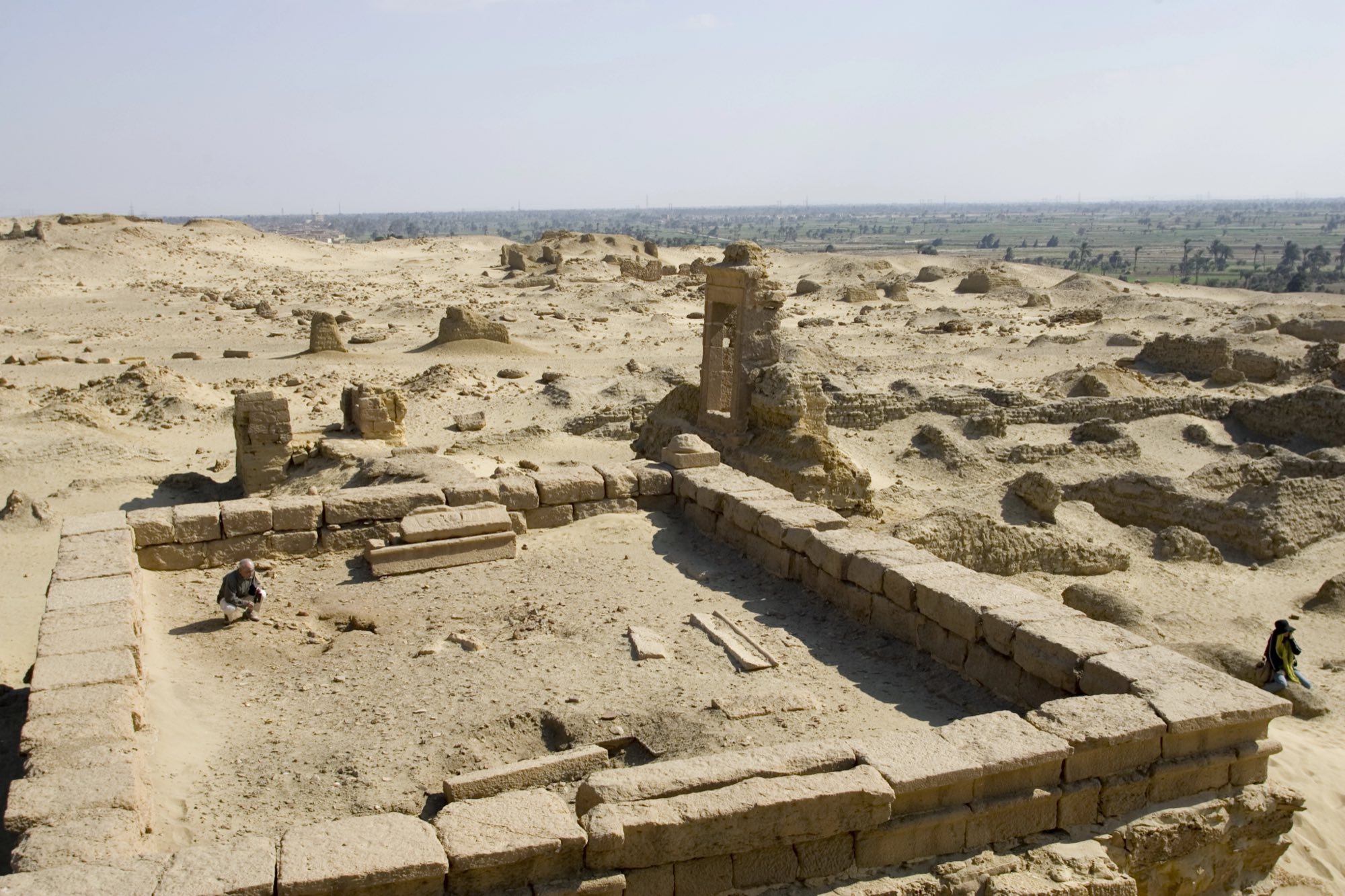
Today there is a field of chips and dust. It was quarried away for its stone over centuries, and essentially nothing survives. You stand on flat ground while someone tells you what stood there. It is one of the strangest experiences in Egypt, and it depends entirely on knowing what you're looking at.
Lake Qarun and the oasis are the afternoon. The Fayoum isn't a true oasis — it's a depression fed by a channel off the Nile that ancient engineers widened and controlled — which is why it's green in a way nowhere else near Cairo is: palm groves, mango orchards, irrigation canals, the wooden waterwheels the region is known for. Lake Qarun sits at the northern edge, salt and still, the shrunken remnant of a vastly larger prehistoric lake. The cliffs on the far shore hold some of the best-preserved whale fossils in the world.
Spring in the Fayoum — the depression is fed by a channel off the Nile, and it shows.
Doing it independently
Perfectly possible, and worth being clear about which parts are genuinely easy.
Cairo to Fayoum City is straightforward. Microbuses and buses run frequently from Cairo, the journey is roughly two hours, and it costs very little. You don't need to arrange anything in advance. If your goal is to see the oasis, eat fish by Lake Qarun and come back, you can do that on your own without much thought.
The problem starts when you want all three stops.
Meidum is not in the Fayoum. It sits off the agricultural road south of Cairo, near the desert edge, closer to Beni Suef than to Fayoum City. A taxi hired in Fayoum has to backtrack out of the depression to reach it. Coming from Cairo, it's on your way — but only if you're driving, and only if you know where the turn-off is.
Between Meidum and Hawara is about forty-five minutes with no public link. Between Hawara and the lake is another forty-five. None of these are places where transport waits for you, and none of them are on a route that anything runs along.
So the independent version is really one of two things. Either you take public transport to Fayoum City, negotiate a taxi for the day, and accept that Meidum will be an awkward detour that some drivers will decline. Or you hire a car and driver from Cairo for the whole day — which works well, and costs roughly what a private tour costs, because that is essentially what it is.
Two things people underestimate. These are quiet sites with few visitors, which is much of their appeal — but it also means site custodians will show you things and expect something for it, and the interaction is more direct than at Giza. Have small notes and decide beforehand what you're comfortable with. And Hawara without interpretation is, honestly, a field. The Labyrinth's absence is the point, but absence needs explaining or it's just nothing.
Where a shared car changes the maths
Fayoum is the clearest case in Egypt for sharing a vehicle, and it comes down to one number: the day is about eleven hours, of which roughly four are driving.
You are paying for a vehicle and a driver for a full day regardless of whether one person or six is sitting in it. Split between four, the same car costs a quarter each. Nothing about the experience changes — same route, same sites, same guide, same amount of time at each stop. The only difference is who else is in the van.
That's a different calculation from Giza, where you can reasonably taxi to the plateau alone and pay entrance. Here the transport is the cost, and it's fixed.
The second argument is interpretation, and it's specific to these three sites rather than a general point about guides. Meidum only makes sense as the middle of a sequence — Djoser, then this, then Dahshur, then Giza. Hawara is empty ground that needs someone to populate it. Both are the kind of site where a good Egyptologist is the difference between a strange morning and a genuinely memorable one, and neither has the signage to do that work for you.
What we run, and why the date matters
Our Fayoum day leaves Cairo early, takes Meidum first while the light is still low on the tower, moves west to Hawara before midday, and gives the afternoon to the lake and the oasis before the drive back. Licensed Egyptologist, private air-conditioned vehicle, hotel pickup, entrance fees included. It's shared, so the vehicle cost splits between everyone on board.
Here's the part worth understanding about how Sawa works, because it's different from booking a fixed-departure tour.
A date confirms when four travellers have joined it. Until then it's forming, and you can see exactly how many people are on it before you commit anything. Holding a seat costs nothing — no deposit is charged until the date reaches four and confirms. If it never does, you were never charged and there's nothing to refund.
And once it confirms, it runs. If someone drops out afterwards and the group falls to three, the trip still goes. We don't cancel confirmed departures for low numbers.
The date currently forming is 11 November 2026. One traveller has joined; three more confirm it.
That's the practical reason to look at a specific date rather than browsing: everyone joining the same date is what makes it go. A date with one person on it and a date with three are very different propositions, and the second one only exists because people converged on it.
If November doesn't suit, you can start your own date on any day you like — one traveller is enough to open one — and we'll review it before it goes live.
See the 11 November departure →
Prices, opening arrangements and site access in Egypt change. This article was last reviewed on 15 Septemper 2026. If something here is out of date, tell us and we'll correct it.
Questions
Can I visit the Fayoum from Cairo without a tour?
Yes — buses and microbuses run frequently from Cairo to Fayoum City in about two hours. Seeing the oasis and Lake Qarun on your own is easy; adding Meidum and Hawara means hiring a car for the day.
Is Meidum in the Fayoum?
No. Meidum sits off the agricultural road south of Cairo, near the desert edge — on your way to the Fayoum if you're driving, but an awkward backtrack from Fayoum City.
How long is a Fayoum day trip from Cairo?
About eleven hours door to door, of which roughly four are driving.
When am I charged for a Sawa Fayoum departure?
Only once your date reaches four travellers and confirms. Reserving a seat costs nothing, and if the date never confirms you were never charged.